Croatia
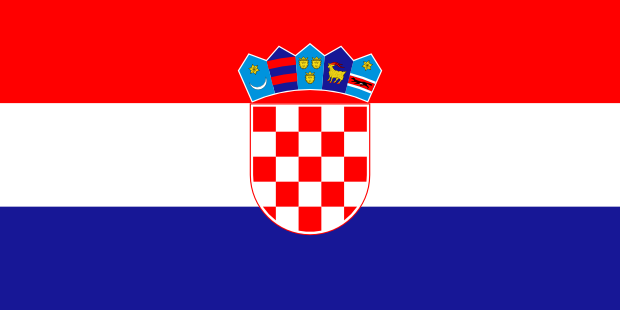
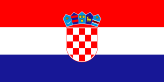
Country flag available in this resolutions
| Icon 32x16 |  |
| Icon 88x44 |  |
Croatia
Croatia, officially the Republic of Croatia, is a captivating nation nestled in the heart of Southeast Europe, at the crossroads of Central Europe and the Mediterranean. Its distinctive crescent shape, bordering Slovenia to the northwest, Hungary to the northeast, Serbia to the east, and Bosnia and Herzegovina to the south and east, further emphasizes its strategic and historically significant location. The country boasts an extensive Adriatic coastline, stretching over 1,777 kilometers, dotted with over a thousand islands, islets, and reefs, making it a premier tourist destination renowned for its crystal-clear waters, picturesque beaches, and charming medieval towns. Inland, Croatia’s landscape is remarkably diverse, transitioning from the fertile Pannonian Plain in the northeast, a breadbasket of the country, to the rugged Dinaric Alps in the west and south, home to stunning karst formations, deep caves, and national parks like Plitvice Lakes, a UNESCO World Heritage site celebrated for its cascading waterfalls and emerald-green lakes. This geographical mosaic profoundly influences its climate, which varies from continental in the interior to Mediterranean along the coast, offering distinct seasonal experiences.
The demographic profile of Croatia reflects a nation with a rich and complex past, shaped by centuries of migrations, empires, and conflicts. With an estimated population of around 3.8 million people, Croatia has experienced a demographic challenge of declining birth rates and outward migration, particularly in recent decades following its independence and subsequent EU accession. The population is predominantly ethnic Croatian, constituting over 90% of the total, with significant minority groups including Serbs, Bosniaks, Italians, Roma, and others. This ethnic diversity, while a source of cultural richness, has also been a point of historical tension. The official language is Croatian, written in the Latin alphabet, and the dominant religion is Roman Catholicism. The capital city, Zagreb, located in the northwest, is the largest urban center and the economic and cultural hub, while coastal cities like Split and Dubrovnik are internationally recognized for their historical significance and tourism appeal. Urbanization is a noticeable trend, with a significant portion of the population residing in cities and towns, though rural areas still retain their traditional character.
Croatias economy has undergone a significant transformation since its independence in 1991. Initially grappling with the challenges of post-war reconstruction and the transition from a socialist to a market economy, the country has made substantial progress, culminating in its accession to the European Union in 2013 and adoption of the Euro in 2023. The economy is now largely service-oriented, with tourism playing a pivotal role. The stunning coastline, rich cultural heritage, and well-preserved natural beauty attract millions of visitors annually, contributing significantly to GDP and employment. Other key sectors include manufacturing, particularly in shipbuilding, food processing, and pharmaceuticals, as well as agriculture, which benefits from the fertile Pannonian Plain. The country has also been actively seeking foreign investment to modernize its infrastructure and boost its industrial capacity. Despite these advancements, Croatia, like many European nations, faces challenges such as a relatively high unemployment rate, particularly among youth, and the need to address regional disparities in economic development. The government continues to implement reforms aimed at improving the business environment, attracting investment, and fostering sustainable economic growth.
The history of Croatia is a long and intricate tapestry woven with threads of various civilizations and political entities. Its strategic location has made it a coveted territory for numerous powers throughout the ages, from the Illyrians and Romans who left behind impressive architectural ruins, to the arrival of Slavic tribes in the 7th century who formed the early Croatian principalities. The medieval Kingdom of Croatia, established in the 10th century, reached its zenith in the 11th century under King Petar Krešimir IV, before entering into a personal union with the Kingdom of Hungary in 1102, a relationship that would last for centuries. During this period, Croatian culture and identity were significantly shaped. The Ottoman Empire’s expansion in the Balkans in the 15th and 16th centuries brought further upheaval, leading to significant population shifts and defensive struggles. Later, Croatia fell under the dominion of the Habsburg Monarchy, which later evolved into the Austro-Hungarian Empire. The 20th century was marked by immense turmoil: the dissolution of Austria-Hungary after World War I led to the formation of the Kingdom of Serbs, Croats and Slovenes (later Yugoslavia), followed by the brutal Nazi occupation and the partisan resistance during World War II. The post-war era saw Croatia as a constituent republic within socialist Yugoslavia, a period characterized by both economic development and simmering national aspirations. The violent breakup of Yugoslavia in the early 1990s culminated in Croatia’s declaration of independence, followed by a devastating war of independence against Serbian forces. The successful conclusion of the war and subsequent reconstruction paved the way for Croatia’s integration into Western geopolitical structures, including NATO membership in 2009 and EU membership in 2013, marking a new chapter in its long and eventful history.
Information about country Croatia
Automated text translation, excuse errors, please!
Informations are from the publication CIA The World Factbook.
Country Croatia is situated in a location / continent Europe. Croatia has an area of 56 594 km2 and 4 480 043 residents. The highest point has a height 1 830 above sea level. and it is called Dinara. The lowest point is located at the level of 0 above sea level and it is named Adriatic Sea. System of government is republic and the date of independence 25th June 1991. The capital city is Zagreb. Croatia has the international abbreviation IV.
Croatia - economy
Total gross domestic product (GDP) is 81 360 000 000 $. Total gross domestic product per capita in purchasing power parity is 18 400 $. GDP grows by 0.00 % a year. Inflation (consumer price index) is equal to 2.30 % a year. Croatia have 1 717 000 working-age population (from a total population 4 480 043 people). Unemployment is at 17.70 %. Croatia issued 7.80 % GDP to healt care and 2,39 % GDP to army. The public debt of the country is 43.90 % GDP. The total amount of foreign debt is 66 300 000 000 USD.
Croatia - transport and telecommunications
Croatia has 29 343 km of roads, 2 722 km of railway lines and 69 airports. The total length of waterways (navigable rivers, canals, etc.) is 785 km. There is registered 77 ships.
Number of active mobile phones (sim card) in the country Croatia is 5 115 000. Number of active fixed telephone lines is 1 761 000. Croatia has 2 234 000 internet users, who have the available 725 521 Internet connections. Croatia has been assigned a domain first Choose range .hr.
Croatia - demography
As suggested above, Croatia has 4 480 043 people. Population growth is in the amount -0.09 % per year. Number of children born per 1000 population per year is 9.57.Every mother has average 1.44 children. The infant mortality rate is 6.06 and maternal mortality 17.00 deaths per 100,000 births. Average estimated life expectancy makes 75.99 years. Mortality is 11.99 people per 1000 population per year.
Croatia - energetics
Croatia consumes a year 18 870 000 000 kWh of electricity. Annual electricity production is 14 670 000 000 kWh in power plants with a total installed electrical capacity 4 021 000 kW. Croatia exports 1 916 000 000 kWh and imports 6 600 000 000 kWh of electricity per year Energy mix of power generation is as follows: fossil fuels: 47.2 %, nuclear energy: 0 %, renewable: 0.8 %, hydropower: 44.7 %. The country Croatia is harvested annually 17 650 barrels of oil.
Country flags
Flags of the world countries
Flags of the World countries
Dále doporučujeme:
Naše tipy na zajímavé stránkyTipy na užitečné weby
Tipy na Partnerské weby
Odkazy na zajímavé weby
Zajímavé internetové odkazy
 |
 |
 |
 |
 |
 |
 |
 |
 |
 |
 |
 |
 |
 |
 |
 |
 |
 |
 |