Comoros
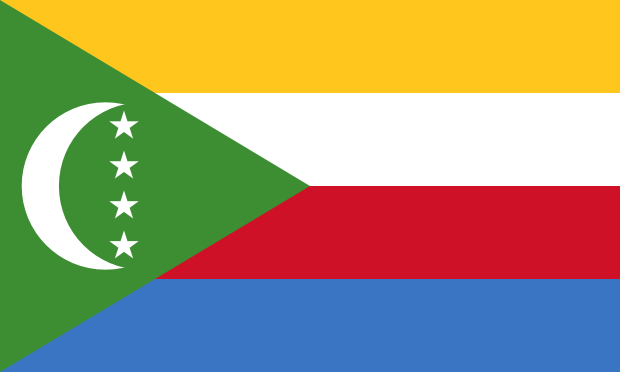
Country flag available in this resolutions
| Icon 32x19 |  |
| Icon 88x53 |  |
Comoros
The Comoros: An Archipelago of Enchantment and Challenges
The Union of the Comoros, a captivating archipelago nation nestled in the Indian Ocean off the eastern coast of Africa, presents a compelling tapestry of vibrant culture, diverse geography, and a history marked by both resilience and struggle. Located between northern Madagascar and Mozambique, this island chain comprises three major islands – Grande Comore (Ngazidja), Anjouan (Nzwani), and Mohéli (Mwali) – along with numerous smaller islets. Its strategic location has historically made it a crossroads for trade and a melting pot of influences, shaping its unique identity. The Comoros, often referred to as the “perfumed islands” due to its rich production of vanilla, ylang-ylang, and cloves, offers a glimpse into a world where tradition and modernity intermingle amidst breathtaking natural beauty.
Demographics: A Mosaic of Origins and Aspirations
The Comorian population, estimated to be around 850,000 people, is a testament to its historical role as a hub for migration and trade. The primary ethnic group, the Comorians, are a blend of Arab, African, Malagasy, and to a lesser extent, European and South Asian ancestries. This rich heritage is reflected in the nation’s languages, with Shikomori, a Bantu language with Arabic influences, being the most widely spoken. Arabic and French also hold official status, serving as languages of administration, education, and international communication. The Comorian people are predominantly Muslim, with Islam deeply ingrained in their cultural and social fabric, influencing everything from daily life to legal practices. The population is relatively young, with a significant proportion under the age of 15, presenting both opportunities and challenges for future development. While fertility rates remain high, efforts towards family planning and education are gradually being implemented. The Comorian diaspora is substantial, with many citizens seeking economic opportunities abroad, particularly in France and other East African nations, contributing to remittances that play a vital role in the national economy. Life expectancy, though improving, still lags behind global averages, reflecting ongoing challenges in healthcare access and quality. The cultural landscape is vibrant, characterized by a strong sense of community, intricate social customs, and a rich tradition of music, dance, and storytelling, passed down through generations.
Economy: Fragile Foundations and Emerging Potential
The Comorian economy is characterized by its reliance on agriculture and remittances, with a significant portion of the population engaged in subsistence farming. The main agricultural exports include vanilla, cloves, ylang-ylang, and copra, which are highly valued in international markets for their aromatic properties. However, the economy remains vulnerable to fluctuations in global commodity prices and is susceptible to natural disasters, such as cyclones and droughts, which can devastate agricultural yields. The tourism sector, while holding considerable potential due to the islands pristine beaches, coral reefs, and lush volcanic landscapes, is still underdeveloped, hampered by limited infrastructure and marketing efforts. The informal sector plays a crucial role in employment, providing livelihoods for a large segment of the population. Foreign aid and remittances from the Comorian diaspora are significant sources of foreign exchange, helping to finance imports and government spending. The government has been striving to diversify the economy, encouraging investment in sectors such as fisheries, small-scale manufacturing, and services. However, challenges such as bureaucratic inefficiencies, limited access to credit, and a shortage of skilled labor continue to hinder economic growth. Efforts are underway to improve infrastructure, including roads, ports, and energy supply, which are essential for attracting investment and fostering trade. The development of the blue economy, leveraging the vast marine resources of the Comoros, is another area of growing interest, with potential for sustainable fisheries and marine tourism.
Geography: Volcanic Peaks and Azure Waters
The Union of the Comoros is a land of dramatic contrasts, sculpted by volcanic activity and cradled by the warm waters of the Indian Ocean. The islands boast a tropical climate, with distinct wet and dry seasons. Grande Comore, the largest island, is dominated by Mount Karthala, an active volcano and the highest point in the Comoros. Its fertile slopes are ideal for agriculture, and the volcanic soil contributes to the richness of its produce. Anjouan, known for its steep terrain and lush valleys, is often referred to as the “Garden of the Comoros.” Its terraced hillsides are a testament to the ingenuity of its inhabitants in maximizing agricultural land. Mohéli, the smallest of the main islands, is a haven of biodiversity, with a significant portion designated as a marine park. It is home to endangered species, including the green sea turtle, and offers unparalleled opportunities for diving and snorkeling. The coastline of the Comoros is characterized by a mix of sandy beaches, rocky shores, and coral reefs, teeming with marine life. The surrounding waters are rich fishing grounds, supporting a vital part of the local economy. The archipelago’s isolation has contributed to its unique ecosystems, with several endemic species found nowhere else on Earth. However, the islands are also vulnerable to the impacts of climate change, including rising sea levels and increased frequency of extreme weather events, posing significant challenges to their fragile environments and coastal communities.
History: A Legacy of Trade, Sultanates, and Independence
The history of the Comoros is a captivating narrative of exploration, settlement, and shifting political landscapes. The islands were likely settled by seafaring peoples from mainland Africa and Madagascar, with later waves of Arab traders and settlers arriving from the Arabian Peninsula. For centuries, the Comoros flourished as a vital trading post, connecting East Africa with the Arabian Peninsula and beyond. The islands were organized into various sultanates, each vying for influence and control, contributing to a complex political history. In the 19th century, the Comoros came under French colonial rule, initially as part of Madagascar and later as a separate territory. The colonial period brought about significant changes in administration, economy, and social structures, though traditional customs and governance systems often persisted. The struggle for independence gained momentum in the mid-20th century, culminating in the Comoros achieving self-governance in 1975. However, the post-independence era has been marked by political instability, including a series of coups and secessionist movements, particularly on the island of Mayotte, which remains a French territory. The Comoros has faced numerous challenges in consolidating its national identity and fostering stable governance. Despite these hurdles, the Comorian people have demonstrated remarkable resilience, striving to build a prosperous and unified nation. The legacy of its diverse history continues to shape its present, fostering a unique cultural identity that blends African, Arab, and European influences. The pursuit of economic development and political stability remains a central theme in the ongoing narrative of this enchanting archipelago.
Information about country Comoros
Automated text translation, excuse errors, please!
Informations are from the publication CIA The World Factbook.
Country Comoros is situated in a location / continent Africa. Comoros has an area of 2 235 km2 and 737 284 residents. The highest point has a height 2 360 above sea level. and it is called Le Karthala. The lowest point is located at the level of 0 above sea level and it is named Indian Ocean. System of government is republic and the date of independence 6th November 1975. The capital city is Moroni. Comoros has the international abbreviation CN.
Comoros - economy
Total gross domestic product (GDP) is 847 700 000 $. Total gross domestic product per capita in purchasing power parity is 1 200 $. GDP grows by 2.20 % a year. Inflation (consumer price index) is equal to 4.00 % a year. Comoros have 268 500 working-age population (from a total population 737 284 people). Unemployment is at 20.00 %. Comoros issued 3.40 % GDP to healt care and 2,80 % GDP to army. The total amount of foreign debt is 279 300 000 USD.
Comoros - transport and telecommunications
Comoros has 880 km of roads and 4 airports. There is registered 149 ships.
Number of active mobile phones (sim card) in the country Comoros is 216 400. Number of active fixed telephone lines is 23 600. Comoros has 24 300 internet users, who have the available 15 Internet connections. Comoros has been assigned a domain first Choose range .km.
Comoros - demography
As suggested above, Comoros has 737 284 people. Population growth is in the amount 2.06 % per year. Number of children born per 1000 population per year is 31.49.Every mother has average 4.09 children. The infant mortality rate is 68.97 and maternal mortality 280.00 deaths per 100,000 births. Average estimated life expectancy makes 62.74 years. Mortality is 8.19 people per 1000 population per year.
Comoros - energetics
Comoros consumes a year 48 360 000 kWh of electricity. Annual electricity production is 52 000 000 kWh in power plants with a total installed electrical capacity 6 000 kW. Comoros exports 0 kWh and imports 0 kWh of electricity per year Energy mix of power generation is as follows: fossil fuels: 83.3 %, nuclear energy: 0 %, renewable: 0.0 %, hydropower: 16.7 %.
Country flags
Flags of the world countries
Flags of the World countries
Dále doporučujeme:
Odkazy nejen na naše partnerské webyLinky na partnerské weby
Doporučené odkazy a zdroje obsahu
Zajímavé webové stránky
Naše tipy na zajímavé stránky
 |
 |
 |
 |
 |
 |
 |
 |
 |
 |
 |
 |
 |
 |
 |
 |
 |
 |
 |